7 Steps to Evaluate Land Before Building a Custom Home in Texas
Learn how to evaluate land before building a custom home in Texas: soil, flood, utilities, zoning, and red flags, with a practical checklist.
The most expensive mistake in a custom home is often made before the first drawing: buying a lot nobody tested.
A parcel can look flat, green, and perfectly priced, then arrive with expansive clay, a flood-zone boundary through the building pad, or no practical way to get water and sewer to it.
If you want to evaluate land before building a custom home in Texas, this guide gives you the checks to run, the order to run them in, and the findings that should make you walk away.
Think of it as a go/no-go scorecard, not a generic lot list.
Why You Should Evaluate Land in Texas Before Design Begins
In Texas, the land decides what the house can be. Soil determines the foundation. Slope determines the grading and the structure. Drainage determines whether the lower level stays dry. Utilities and restrictions determine what you are even allowed to build.
That is why land evaluation belongs ahead of floor plans and finishes. A design drawn for an imagined lot often has to be redrawn for the real one, and the redraw is where budgets slip.
If you are still mapping the full journey, our guide to building a custom luxury home in Texas shows where land fits in the sequence.
The good news: most land problems are discoverable for a few thousand dollars, before you are committed. You just need to look in the right places.
The 7 Checks to Run Before You Buy Land to Build in Texas
1. Soil and the geotechnical report
Texas is known for expansive clay, soil that swells when wet and shrinks when dry. Across much of North and Central Texas, that seasonal movement is the main threat to a slab or foundation.
A geotechnical report is the only objective way to know what you are building on.
A geotechnical engineer drills borings at or near the building pad, tests the soil, and recommends a foundation approach.
Many engineers treat a Plasticity Index above roughly 30 as a flag for highly expansive soil.
What to ask for:
Soil classification and Plasticity Index
Depth to bedrock or groundwater
Recommended foundation type (slab, stiffened slab, drilled piers, beams)
Any soil treatment or select-fill requirements
The report turns "is this lot okay?" into a number you can budget against.
For more on how structure and engineering protect long-term value, see our structural details guide.
2. Topography, drainage and flood risk
Walk the land, ideally after a heavy rain. Look for where water enters, pools, and leaves. Note natural drainage paths, low spots, erosion lines, and creek crossings.
Then check the maps. The FEMA Flood Map Service Center shows mapped flood zones, but maps can lag real conditions, so also ask the local floodplain administrator about the specific parcel.
A lot partly in a floodplain can still be buildable, but it can change the pad elevation, insurance cost, and lender requirements.
Steep slopes add cost through retaining walls, cut and fill, and deeper foundations. They can also deliver the views that make a site special. Slope is a pricing question as much as a risk question.
You can also read: The Importance of Waterproofing & Drainage in Texas Estate Homes
3. Utilities: city services, well and septic
Confirm what is actually at the property line. Water, sewer, electric, gas, and high-speed internet each have different distances and connection costs.
On rural and Hill Country parcels, plan for a private well and an on-site septic system.
Septic systems in Texas are permitted through authorized local agencies under the TCEQ on-site sewage facility program, and soil conditions can limit which system type works. Water availability for wells also varies by region and groundwater district.
Get written quotes before you close. A utility run of several hundred feet can change the entire land-to-build budget.
4. Zoning, deed restrictions, HOA and ETJ
Texas counties generally have limited zoning power, so deed restrictions and HOA rules often do the work that zoning does in other states. Read them before you buy.
They can control minimum square footage, setbacks, height, materials, rooflines, fencing, and even paint colors.
Also find out whether the parcel is inside a city, outside it, or in a city's extraterritorial jurisdiction (ETJ). That affects platting rules, permits, and inspections. If you plan an outbuilding, guest house, or pool, confirm these are allowed too.
You can also read: Custom Home Allowances Explained: A Texas Budget Guide
5. Access, easements, and survey
A current survey shows boundaries, easements, encroachments, and setbacks. It tells you how much of the parcel you can actually build on, which is often less than the acreage suggests.
Check legal access as well. A lot with no recorded access, or an access road shared with neighbors, can create problems later.
Have a title company review easements, mineral rights, and any recorded restrictions.
6. Orientation, views and building envelope
Texas sun is a design input. A west-facing glass wall without shading can raise cooling loads and hurt comfort.
Prevailing breezes, mature trees, and the direction of the best views all shape where the home should sit.
Sketch the building envelope early: the area left after setbacks, easements, drainage paths, and trees to preserve. If your dream plan does not fit inside it, you want to know before you buy.
You can also read: Build vs Buy a Luxury Home in Texas: Which is Better?
7. Regional hazards: wildfire, wind, and hail
Hazards differ by region. Hill Country and rural sites may face wildfire exposure, while North Texas is known for hail and high winds.
These do not rule out a lot, but they affect roofing, cladding, and structural choices.
See our guides on fire-resistant construction and how the Texas climate shapes luxury home design.
Texas Land Risk by Region
Conditions vary parcel by parcel, even within the same neighborhood.
Use this table as a starting point for what to investigate first, not as a substitute for a site-specific report.
Region | What to investigate first | Why it matters |
|---|---|---|
DFW and North Texas (Southlake, McKinney, Frisco) | Expansive clay, HOA and deed rules, hail exposure | Foundation design and exterior material choices drive cost |
Central Texas and Hill Country | Shallow limestone, slope, well water, wildfire | Excavation, utilities and structure can all change the budget |
Lake Travis and Lago Vista | Steep grades, bedrock, shoreline rules, view orientation | Site work and foundation can cost more but unlock premium views |
Houston and Gulf Coast | Flood zone, high water table, drainage, wind | Pad elevation, insurance and moisture control come first |
If you are considering a lakefront parcel, our Lake Travis lakefront guide covers shoreline-specific questions, and our Lago Vista custom homes page shows what we have built in that market.
What Land Checks Cost vs. What Skipping Them Costs
Due diligence is little money compared with the problems it prevents. The ranges below are general market figures, not TX Sparks Luxury Homes quotes, and vary with acreage and location.
Always request local quotes.
Check | Typical cost (general range) | Risk if skipped |
|---|---|---|
Geotechnical report | Roughly $1,500 to $5,000 | Foundation redesign or upgrades that can run into five figures |
Boundary and topographic survey | Varies widely with acreage | Building on easements or inside setbacks |
Septic soil evaluation | Roughly $600 to $1,500 | A system that costs far more than budgeted, or fails approval |
Flood and floodplain check | Low or no cost | Higher insurance, raised pad, lender complications |
Utility quotes | Often free to request | Long, expensive utility extensions |
Title and restriction review | Title and legal fees | Hidden easements or rules that block your plan |
The pattern is consistent: a few thousand dollars of checking can prevent a change order many times larger.
For how to protect the rest of the budget, read our guide to avoiding cost overruns, and see how to finance a custom luxury home in Texas, since land loans often have different terms than construction loans.
Red Flags That Should Stop the Purchase
Some findings call for renegotiation or a hard walk-away. Treat these as pause points:
No legal, recorded access to the property.
Building pad inside a mapped floodplain with no realistic engineering solution.
A geotechnical report recommending extensive remediation far beyond your budget.
Failed or marginal septic soils on a parcel with no sewer option.
Deed restrictions that conflict with your design, such as size, height, or material limits.
Utility extensions priced at a large share of the land cost.
A usable building envelope too small for the home you want, after setbacks and easements.
Seller reluctance to allow inspections or a feasibility period.
One red flag is a negotiation. Several together usually mean the land is the wrong one.
You can also read: 7 Things to Expect When Building a Luxury Custom Home
How to Evaluate Land Before Building a Custom Home in Texas: Step by Step
Run the checks in an order that spends the least money first and stops you early if something fails.
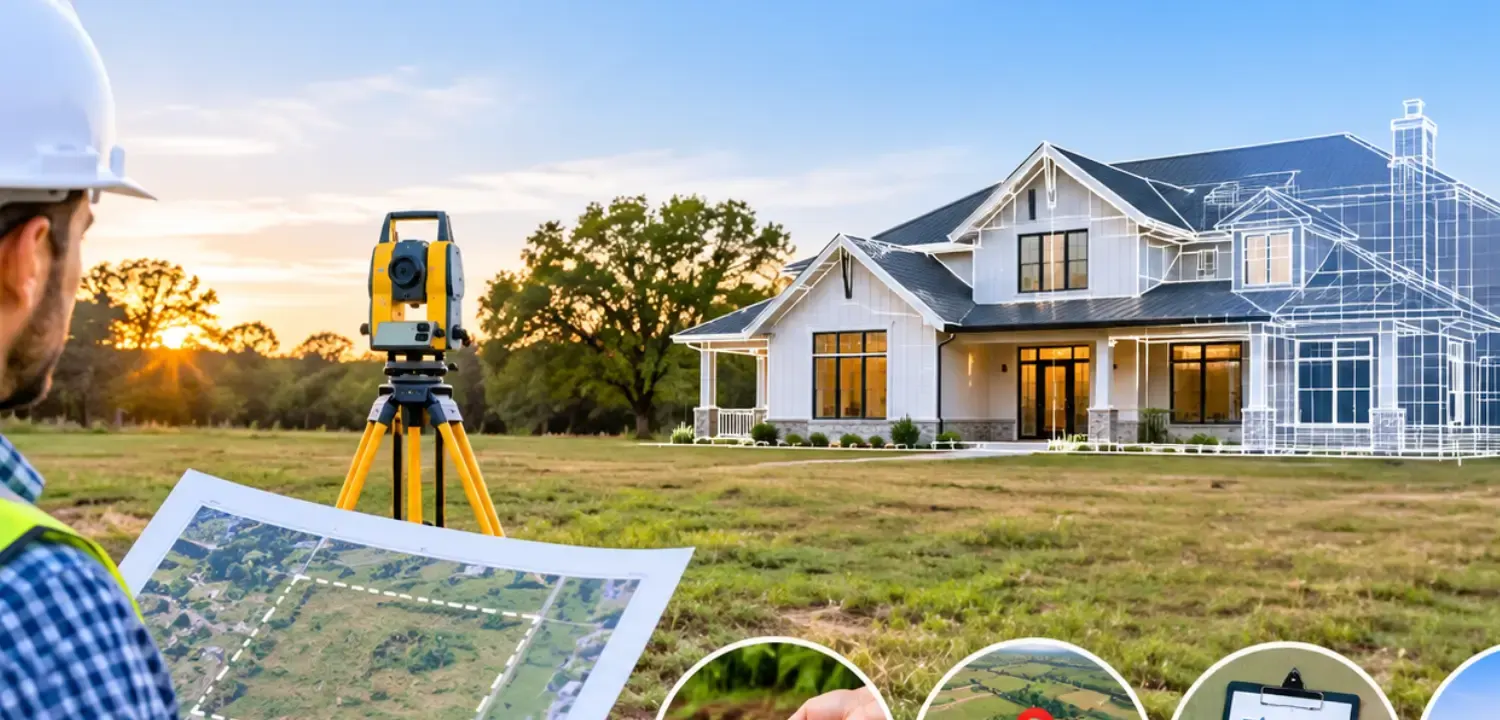
Define the home you want to build. Rough size, style, and must-haves tell you how much land you actually need.
Do a desktop review. Check flood maps, zoning or restrictions, utility availability, and nearby sales before visiting.
Walk the site with a builder or engineer. Bring someone who can read slope, drainage, and access on site.
Secure a feasibility or inspection period in your purchase contract. Terms vary, so confirm with your attorney or agent.
Order the survey and title review.
Commission the geotechnical report and septic evaluation within that window.
Collect written utility quotes.
Build a land-to-home budget that combines purchase price, site work, utilities, foundation, and design.
Make the go/no-go decision against your red-flag list, then close or renegotiate.
This order keeps your risk small. You only pay for the expensive reports once the cheap checks have passed.
You can also read: Top 10 Custom Home Builders in Texas (2026)
Bring Your Builder In Before You Make an Offer
Most buyers involve a luxury home builder in Texas after they own the land. By then, the biggest decisions are already locked in.
A builder who understands engineering can translate site findings into real cost and design consequences: which foundation the soil calls for, how slope affects the structure, and whether a different framing approach, such as light-gauge steel framing, suits the site and climate.
That early view helps you decide whether to buy, what to offer, and how to plan the build.
If you are still comparing teams, our guide to choosing a custom home builder in Texas lists what to ask.
Frequently Asked Questions
1. How much does it cost to evaluate land before building a house in Texas?
Expect a few thousand dollars in total for the key checks: a survey, a geotechnical report, a septic evaluation if needed, and title review. Costs vary with acreage, region, and the number of borings required. Get local quotes, because rural or sloped sites typically cost more to test.
2. What makes land unbuildable in Texas?
Common causes include no legal access, a building pad in a floodplain, failed septic soils with no sewer option, restrictive deed covenants, or soil conditions that make the foundation cost unrealistic. Land is rarely absolutely unbuildable, but it can be impractical at your budget.
3. Do I need a soil test before buying land in Texas?
Yes, for a custom home, a geotechnical report is strongly recommended. Expansive clay is widespread across Texas, and the soil result determines foundation design and cost. Order it during your feasibility period so the findings can inform your decision before closing.
4. Can you build a custom home on expansive clay soil?
Yes. Expansive clay is manageable with engineered solutions, such as stiffened slabs, deeper grade beams, drilled piers, or soil treatment. These add cost, which is why the geotechnical report should come before you buy, not after the design is finished.
5. How do I check if a Texas lot is in a flood zone?
Start with the FEMA Flood Map Service Center by entering the property address. Then confirm with the local floodplain administrator, since maps can lag actual conditions. Ask whether an elevation certificate exists and how flood zone status affects insurance and lender requirements.
6. How long does it take to evaluate land before building?
A thorough evaluation usually takes a few weeks, driven by survey scheduling, drilling and lab results, and utility quotes. Building the checks into a feasibility period in your contract keeps the timeline realistic and lets you decide before you are committed.
7. Conclusion: Start With the Land, Then Design the Home
To evaluate land before building a custom home in Texas, check the soil, water, utilities, restrictions, access, and regional hazards first, in an order that spends the least money early. Build a land-to-home budget, weigh it against your red-flag list, and decide before you close.
Land that tests well gives you a home that is easier to design, price, and build. Land that tests poorly tells you something valuable while you can still walk away.
Ready to look at a parcel with an engineer's eye? Start your custom luxury home journey with TX Sparks Luxury Homes, and we will help you assess the site before you commit.