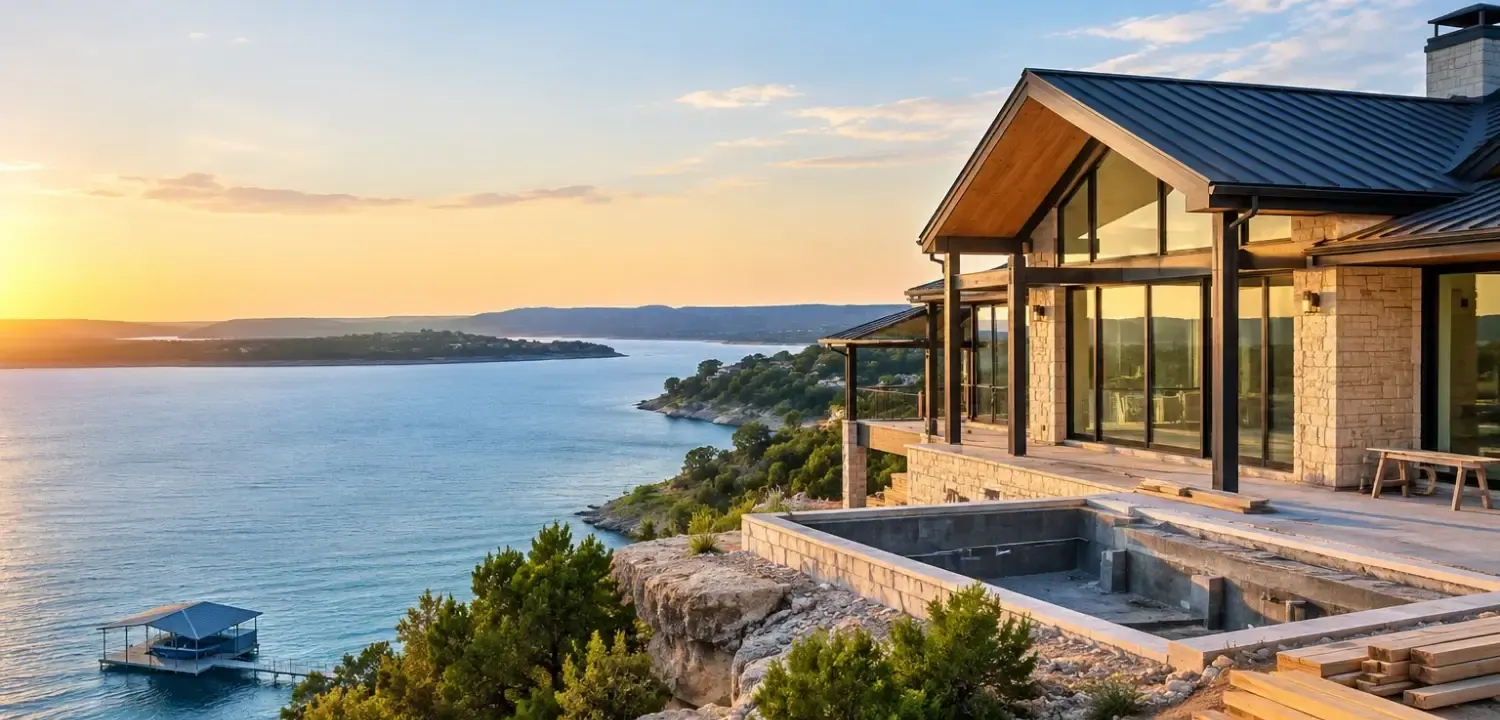
Building a Lakefront Home on Lake Travis: What to Know First
Planning a lakefront home on Lake Travis? Learn the flood elevations, LCRA dock and septic rules, lot red flags, and costs to check before you buy or build.
Lake Travis can lap at your dock one spring and leave it resting on dry limestone a few years later.
Since the dam was built, the lake has ranged from a record low of 614.18 feet in 1951 to a record high of 710.44 feet in December 1991.
That's a swing of roughly 96 feet, and very few buyers plan for it.
A lakefront home on Lake Travis is one of the best ways to own a piece of the Texas Hill Country. It's also one of the most technical builds in the state.
This guide covers what to know first: the elevations that decide where your home can sit, how to judge a lot, the rules that apply, and the design choices that make a lake home work in both drought and flood.
Why Lake Travis Is Different From Other Texas Lakes
Lake Travis is not a constant-level lake. It's a storage reservoir behind Mansfield Dam, managed by the Lower Colorado River Authority (LCRA) for water supply, and it is also designed to temporarily hold floodwaters in its flood pool.
That dual role means the shoreline you see on a showing is a snapshot.
The same lot can look like deep-water frontage in a wet year and a long walk across exposed lakebed in a dry one.
Lake level | Elevation (feet above mean sea level) | Why it matters for your build |
|---|---|---|
Record low | 614.18 (1951) | Shows how far the shoreline can retreat |
Recent drought low | 618 (2013) | The lowest level in modern ownership memory |
Full (conservation pool) | 681 | The "normal" shoreline in listings |
Record high | 710.44 (Dec. 1991) | Highest level the lake has actually reached |
Mansfield Dam spillway | 714 | Above this, water flows over the spillway |
100-year flood elevation | 722 | Used by Travis County for floor elevations |
Know Your Elevations Before You Buy
If you remember one thing from this guide, make it this: buy the lot by its elevations, not its view.
Lake Travis is considered full at 681 feet, but the land above that line isn't automatically safe to build on.
The flood pool extends to the spillway at 714 feet, and Travis County development approvals have referenced the Lake Travis 100-year FEMA floodplain elevation of 722 feet, with finished floors placed one foot above it.
On a lot where the shoreline sits in the 680s, that can put your lowest finished floor 40 feet or more above the water.
It changes where the house sits, how many levels it needs, and how you reach the dock. Confirm the current requirement with the city or Travis County floodplain administrator before you design.
Expert insight: Before closing, ask your surveyor for a topographic survey with the 681, 714, and 722 contour lines drawn on it.
If the buildable pad above 722 is small, steep, or awkwardly shaped, you've learned more about the lot than any listing photo will tell you.
You can also read: Cost-Plus vs. Fixed-Price Contracts for Texas Luxury Homes.
Choosing a Lakefront Lot on Lake Travis
Two lots with similar asking prices can produce very different homes and budgets.
Here's how to read Lake Travis waterfront lots like a builder.
Main Basin vs. Coves
Shallow coves are usually the first places to lose usable water when the lake drops. Main-basin and deep-cove frontage keeps water at the dock longer.
The Texas Water Development Board's volumetric surveys of Lake Travis map the lakebed and can help you understand how your shoreline behaves at lower levels.
Slope and Rock
Much of the Lake Travis shoreline is steep limestone.
That brings rock excavation, retaining walls, engineered driveways, and pier or stepped foundations.
A geotechnical report is essential, and it should come before design, not after.
Orientation and Views
The view that sells a lot often faces west across the water, which also means the hottest afternoon sun.
Plan shading, overhangs, and glass performance from the first sketch.
Jurisdiction
Inside a city such as Lago Vista, Lakeway, Point Venture, or Jonestown, the city handles building permits. In unincorporated areas, Travis County issues development permits.
Most lakefront neighborhoods also have HOA or POA architectural rules. Check all three layers early.
Utilities
Confirm water service (public utility, well, or a permitted lake pump for irrigation) and whether central sewer is available. If it isn't, the septic system becomes a major design constraint.
Our Lago Vista custom homes page shows how we approach lots on the north shore of Lake Travis.
4 Permits and Rules for Building a Lakefront Home on Lake Travis
Building on Lake Travis means working with more than one agency. Here's who governs what.
1. Highland Lakes Watershed Ordinance
Development and other land-disturbing activities within the Lake Travis watershed in Travis County fall under LCRA's Highland Lakes Watershed Ordinance and may need an LCRA permit.
Your civil engineer should address stormwater and water quality controls in the site plan.
2. Septic Systems
LCRA has regulated septic systems within a 2,000-foot zone around Lake Travis since 1971, acting as the state's authorized agent.
A licensed site evaluator must determine the type and size of system your property needs.
On a sloped lot, the drain field can claim some of the flattest, most usable ground. Locate it before the architect places the house, pool, and outdoor living areas.
3. Endangered Species Habitat
Western Travis County is home to the endangered golden-cheeked warbler. Before clearing, check the Balcones Canyonlands Conservation Plan habitat map to see whether your lot may contain habitat.
If it does, Travis County offers a streamlined permit.
It provides habitat determinations within three weeks, charges mitigation fees of $5,500 per acre for confirmed habitat and $2,750 per acre for unconfirmed habitat, and prohibits clearing from March 1 through August 31 on properties with warbler habitat.
That clearing window alone can shift a construction start by months, so plan for it.
4. Shoreline and Lakebed Work
When Lake Travis is below 676 feet, owners can do some lakebed clearing that disturbs sediment, but LCRA requires notification first.
Dredging more than 500 cubic yards or disturbing more than 500 linear feet of shoreline requires an individual LCRA permit.
You can also read: Top 10 Custom Home Builders in Texas (2026).
Designing a Lakefront Home on Lake Travis That Moves
A great Lake Travis home is designed around the lake's range, not its average.
Elevation first: Set finished floors above the flood elevation, then use the slope for walk-out levels, terraces, and garages designed with your engineer and floodplain administrator.
Structure for big glass: Lake views mean long spans and large openings. Steel framing handles those spans and resists moisture and termites. Compare options in LGS vs. traditional wood framing and see how structural steel enhances modern Texas home design.
Control the west sun: Deep overhangs, insulated low-E glass, and thermally broken window frames keep view rooms comfortable.
Durable exteriors: Metal roofing, aluminum windows and moisture-resistant materials hold up to Hill Country storms and lakeside humidity.
Outdoor living that steps down: Terraces, pools and paths should be engineered as part of the slope, not added later.
For more on climate-driven design, read how Texas climate influences luxury home design and materials.
Planning Your Dock
For many buyers, the dock is the reason to be on the water.
LCRA doesn't require a permit, registration, or fees for residential docks of 1,500 square feet or less, and on Lake Travis, a dock can extend no more than 100 feet from the shoreline. Larger docks need a permit.
Because the lake moves so much, most owners choose floating docks. Plan the anchoring, gangway, and power so the dock works at both low and high water.
Floods can be hard on docks: after recent high water, residents described debris and damaged docks across the lake. Design the dock with the same care as the house.
You can also read: Why Does a Custom Home Cost More Than a Production Home?
What Drives the Cost of a Lake Travis Home
Lakefront lots carry costs that a flat suburban lot doesn't. The biggest drivers are:
Rock excavation, retaining walls, and engineered foundations on steep lots
Driveways and access on grades
Septic design and installation where sewer isn't available
Endangered species mitigation fees and clearing-window delays
Elevating the home above flood elevation
Large glass walls and the structure to support them
Dock construction, gangways and shoreline work
For price-per-square-foot ranges and a sample budget, see our guide to luxury home construction costs in Texas, and learn how to prevent cost overruns in luxury home construction.
Lakefront Due-Diligence Checklist
Work through these before you close on a lot or sign with a custom home builder in Lakefront:
Get a topographic survey showing the 681, 714, and 722 elevation lines.
Confirm the floodplain and finished floor requirement with the city or county.
Order a geotechnical report for the likely building pad.
Identify the permitting authority: city, Travis County, or both.
Review HOA or POA architectural rules and deed restrictions.
Confirm water and sewer service, or have a site evaluator assess septic.
Check the BCCP habitat map and request a habitat determination if needed.
Review the cove's depth and how the frontage looks at low lake levels.
Check existing dock size, condition, and permit status.
Ask your builder for a site-specific budget before you finalize design.
For the full build process from land to keys, see 9 steps to build a custom luxury home in Texas.
Why Build Your Lake Travis Home With TX Sparks Luxury Homes
TX Sparks Luxury Homes builds in Lago Vista and across the Lake Travis area.
As one of the luxury custom home builders in Texas that bring commercial-grade construction concepts into residential design, we're built for the demands of a lakefront site.
Site selection guidance and feasibility reviews before you commit to a lot
Bespoke design with detailed 3D renderings that place the home around elevations, views, and septic
Steel/LGS framing, standing-seam metal roofing, aluminum window systems, and upgraded insulated glass as part of how we build
Permits, approvals, interiors and construction handled by one accountable team
See finished and active residences in our properties portfolio, and how we delivered a 5,000 sq ft custom home in 11 months.
Conclusion: Building Your Lakefront Home on Lake Travis
A lakefront home on Lake Travis rewards owners who plan for the lake's full range.
Buy the lot by its elevations, check every agency that has a say, design for heat, slope, and moving water, and build a dock that works in drought and flood.
Get those decisions right before you close, and the rest of the build gets easier. Thinking about a lot on Lake Travis?
Book a consultation with TX Sparks Luxury Homes, or start your Project Blueprint to review the land, budget, and timeline before you buy.
Frequently Asked Questions
1. Do I need a permit to build a dock on Lake Travis?
Not for most homes. LCRA doesn't require a permit, registration, or fees for residential docks of 1,500 square feet or less.
On Lake Travis, docks can extend no more than 100 feet from the shoreline. Larger docks need an LCRA permit, and your city or HOA may have additional rules.
2. How high does my house need to be on Lake Travis?
Travis County development approvals have referenced the Lake Travis 100-year FEMA floodplain elevation of 722 feet above mean sea level, with finished floors placed at least one foot above it.
Requirements can vary by jurisdiction and change over time, so confirm with your city or the Travis County floodplain administrator.
3. Can I use a septic system on a Lake Travis lot?
Yes, but it's tightly regulated. LCRA permits and inspects septic systems within a 2,000-foot zone around Lake Travis.
A licensed site evaluator determines the type and size of system your lot needs. Plan the drain field early, because it affects where the house, pool, and driveway can go.
4. How much does the Lake Travis water level change?
A lot. Lake Travis is full at 681 feet, but it fell to a record low of 614.18 feet in 1951 and to about 618 feet in 2013. Its record high was 710.44 feet in December 1991.
Lot selection and dock design should account for both extremes.
5. Do I need an endangered species permit to build near Lake Travis?
Possibly. Parts of western Travis County contain golden-cheeked warbler habitat. Check the Balcones Canyonlands Conservation Plan habitat map before clearing.
If habitat is present, Travis County offers a streamlined permit with per-acre mitigation fees, and clearing is not allowed from March 1 through August 31.