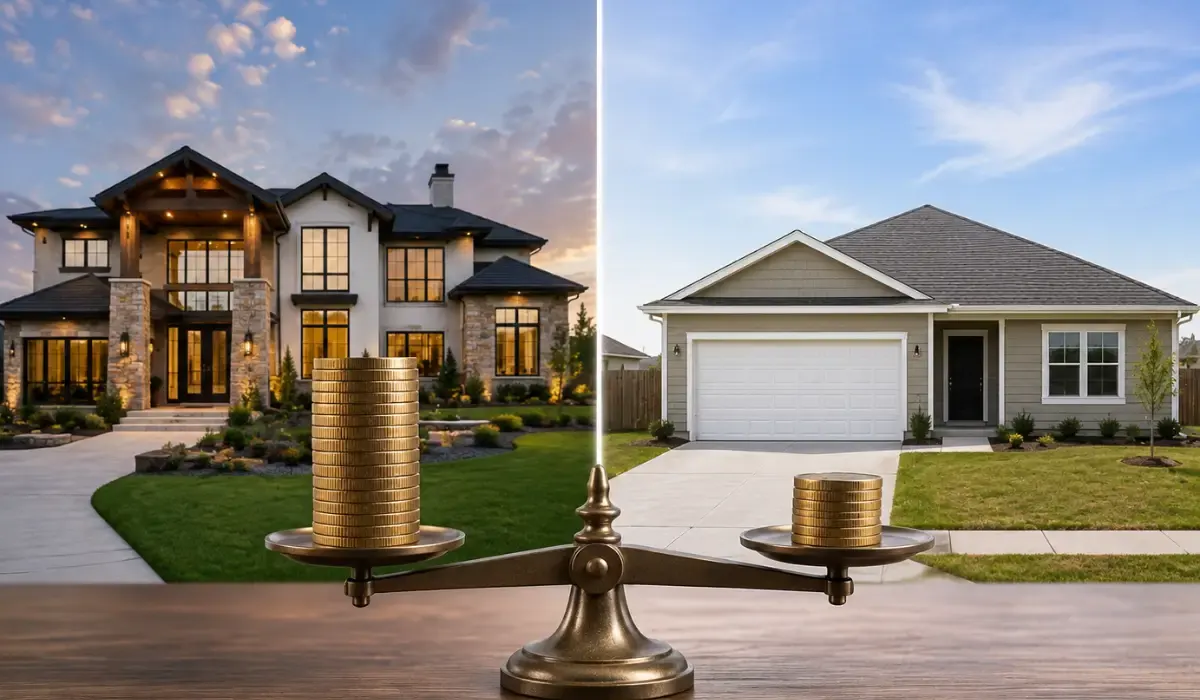
Why Does a Custom Home Cost More Than a Production Home?
Discover why custom homes typically cost more than production homes, from design fees to materials, labor, engineering, customization, and more.
One of the most common and genuine questions we hear from prospective homeowners at TX Sparks Luxury Homes is:
“Why can a production home builder build a home for significantly less per square foot than a custom home builder?”
It is an excellent question.
At first glance, both builders appear to be purchasing the same basic things—concrete, lumber or steel, windows, flooring, countertops, cabinets, plumbing fixtures, lighting, and labor.
So why is there such a difference?
Based on our experience in construction and custom-home building, the answer primarily comes down to economies of scale, purchasing power, labor efficiency, overhead, customization, and construction time.
1. Production Builders Buy Materials in Bulk
This is one of the biggest advantages production builders have.
A production builder may be constructing dozens or even hundreds of homes using many of the same or similar materials.
They may repeatedly purchase the same:
Carpet, engineered wood flooring, windows, glass, countertops, cabinets and millwork, plumbing fixtures, lighting fixtures, doors, hardware, appliances and many other materials.
Because they purchase large quantities and provide suppliers with continuous business, they can often negotiate substantially better pricing.
A custom home is completely different.
The homeowner may select a particular European window system, natural stone, specialty flooring, custom cabinetry, unique lighting, imported fixtures or other products specifically for that one residence.
Instead of ordering materials for 50 or 100 similar homes, the custom builder may be ordering them for one home.
That difference in purchasing power can have a meaningful impact on the overall construction cost.
2. Production Builders Have Significant Labor Advantages
Labor is another major difference.
Large production builders generally work with the same established groups of:
Framers, plumbers, electricians, HVAC contractors, painters, drywall crews, roofers, flooring installers, and other trades.
These crews can continuously move from house to house within the same community.
Imagine an electrical contractor completing one home today and moving two streets away to begin another home tomorrow.
There is very little additional mobilization.
The subcontractor also knows that the builder may provide dozens of additional homes throughout the year. That volume allows the production builder to negotiate better labor pricing.
A custom builder operates differently.
We assemble specialized trades based on the design, complexity, specifications, and quality requirements of an individual home.
The subcontractor may be mobilizing specifically for one project rather than receiving continuous repetitive work within the same subdivision.
That naturally affects labor and mobilization costs.
3. One Superintendent Can Manage Many Production Homes
Production construction is designed around repetition and efficiency.
The floor plans, materials, construction details, subcontractors, and processes are often very similar from one home to another.
Because of this standardization, a production builder may have a relatively small management team overseeing dozens of homes simultaneously.
Custom homes require significantly more individual attention.
A luxury custom residence can involve:
Architects, structural engineers, interior designers, landscape architects, specialty consultants, custom fabricators, homeowners, vendors, and numerous specialized subcontractors.
There may be hundreds of individual decisions throughout construction.
Even if a custom builder is managing only a few homes, the company still needs project management, superintendent oversight, accounting, estimating, scheduling, procurement, and administrative support.
That overhead is distributed across far fewer homes.
4. Customization Itself Has a Cost
This is sometimes overlooked.
Production builders achieve efficiency by asking: “How can we build this home repeatedly?”
Custom home builders are solving a different problem: “How can we build this particular home exactly for this homeowner and this property?”
A custom home may require unique architectural details, structural engineering, custom millwork, specialty windows, complex rooflines, unusual spans, premium finishes, specialty lighting, home automation, pools, outdoor living areas, and numerous owner-driven selections.
Every unique condition requires additional design, coordination, procurement, installation, and quality-control effort.
You're not simply purchasing different materials.
You're purchasing the additional professional effort required to successfully integrate those materials into a one-of-a-kind home.
You can also read: How to Avoid Cost Overruns in Custom Home Construction.
5. Construction Time Has a Major Financial Impact
Time is another major cost difference.
A standardized production home can often move through construction considerably faster because the builder already knows the plans, specifications, vendors, and sequencing.
A true luxury custom home can take significantly longer depending on its size, complexity, permitting, design changes, specialty materials, and owner selections.
During that entire construction period, the custom builder continues carrying:
Project management, superintendent costs, insurance, temporary utilities, site facilities, equipment, accounting, administration, financing-related costs, and other project overhead.
The longer and more complex the project, the greater the carrying cost.
You can also read: Cash vs. Debt for Luxury Homes: How to Choose the Right Strategy.
So, Is a Production Home a Better Value?
Not necessarily.
It depends entirely on what the homeowner wants.
A production home is an excellent solution for someone who prioritizes price, speed, and predictability and is comfortable selecting from predefined plans, materials, and options.
A custom home serves a fundamentally different purpose.
It allows the homeowner to make decisions around:
Architecture, floor plan, lot orientation, room sizes, ceiling heights, windows, structural features, kitchens, cabinetry, flooring, lighting, technology, outdoor living, and virtually every other aspect of the residence.
The homeowner isn't simply choosing a house.
They are creating a home around their lifestyle, property, preferences, and long-term vision.
Conclusion
The higher cost of a custom home doesn't necessarily mean the custom builder is simply charging more for the same product.
The two business models are fundamentally different.
Production Home = Standardization + Volume Purchasing + Repetitive Labor + Faster Construction.
Custom Home = Personalization + Individual Procurement + Specialized Trades + Greater Management + Longer Construction.
At TX Sparks Luxury Homes, we believe homeowners should understand these differences before deciding which approach is right for them.
Our objective is not to convince everyone that a custom home is the better choice.
Instead, we want our clients to understand where their construction dollars are going and what additional value they receive when creating a truly custom residence.
TX Sparks Luxury Homes: Building homes around your vision, lifestyle, and expectations.